Organiser | Shared Task: ASR and Language Resources for Indigenous Languages
Oct 28, 2026· ·
0 min read
Elwin Huaman
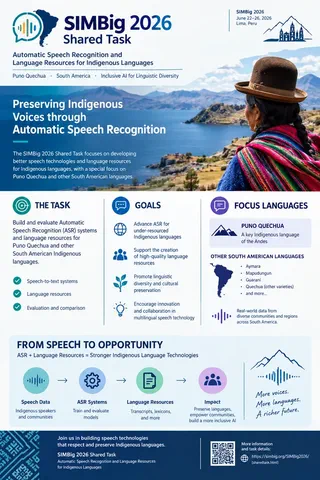 Photo by @ElwinHuaman
Abstract
Most Indigenous languages of South America have no speech recognition system. This shared task invites teams to change that, starting with Puno Quechua (qxp), whose 66-hour community-collected corpus is openly available on Mozilla Data Collective. Task 1 asks teams to build and improve a Puno Quechua ASR system on the Common Voice Scripted and Spontaneous Speech datasets, evaluated with WER and CER against an open baseline. Task 2 asks for ASR for any Indigenous language of South America that has no ASR system yet, with released datasets and train/dev/test splits. Task 3 asks for educational and literacy resources (websites, tutorials, notebooks, visualisations, videos or learning platforms) that help people learn, listen to or reuse an Indigenous language. Winning teams receive prizes, free SIMBig 2026 registration and, after revision, publication in Springer’s CCIS series. Results are announced during SIMBig 2026. Organised by Elwin Huaman (University of Cambridge), Johanna Cordova (ERTIM, Inalco), Juan Antonio Lossio-Ventura (National Institutes of Health) and Hugo Alatrista-Salas (De Vinci Research Centre), with an advisory committee of Anna Korhonen (University of Cambridge) and Damien Nouvel (ERTIM, Inalco).
Event
Location
SIMBig 2026
Arequipa, Arequipa

Authors
Research Engineer
Elwin Huaman is a Quechuan Researcher from Nuñoa Peru, working in the Centre for Human-Inspired Artificial Intelligence at the University of Cambridge. He has experience creating Knowledge Graphs within the civil society, academia and industry. He has co-authored the book: Knowledge Graphs - Methodology, Tools and Selected Use Cases, and is founder of QuechuaBase, a knowledge base ecosystem that supports a harmonization process of the language and knowledge of Quechua communities across the world while promoting their agency and digital inclusion.