Results of the SIMBig 2026 Shared Task on Speech Recognition for Indigenous Languages

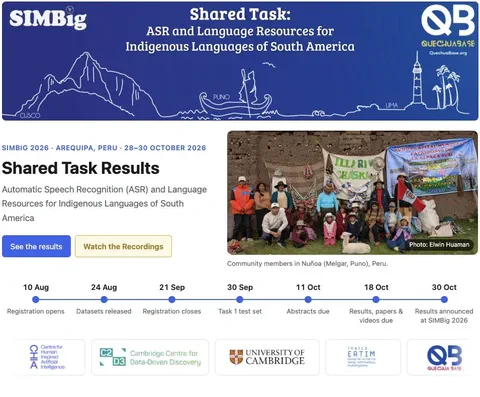 Image credit: Elwin Huaman
On 30 October 2026, at SIMBig 2026 in Arequipa, Peru, we announced the results of the Shared Task on Automatic Speech Recognition (ASR) and Language Resources for Indigenous Languages of South America. In an earlier post I explained why we organised it: Puno Quechua now has a 66-hour, community-collected speech corpus, and a corpus only matters if people use it. Here is what happened when we opened it to everyone.
Participation in numbers
- 35 teams registered from 14 countries.
- 28 teams registered for Task 1 (Puno Quechua ASR), 15 for Task 2 (ASR for any Indigenous language of South America) and 17 for Task 3 (educational and literacy resources). Teams could take part in more than one task.
- Every submission included a system description paper, reviewed by at least two reviewers, and a 15-minute video. Two papers were accepted.
Task 1: Puno Quechua speech recognition
Teams trained their systems on the Mozilla Common Voice Puno Quechua datasets (scripted and spontaneous speech) and were evaluated on a held-out test set of 659 clips (59 minutes, 7 speakers). The main metric is word error rate (WER); lower is better.
| Rank | Team | Best system | WER (%) | CER (%) |
|---|---|---|---|---|
| 1 | Chana-NLP | Chana-L | 11.93 | 2.57 |
| 2 | Espiral | Espiral | 13.37 | 2.80 |
| 3 | Uyariq | Uyariq | 14.87 | 3.08 |
| 4 | 🐣_en_🏡 | 🐣_en_🏡 | 16.10 | 3.37 |
| 5 | Innova | Innova | 17.16 | 3.47 |
| — | Strongest baseline | omniASR LLM-7B v2 | 18.81 | 3.50 |
The full leaderboard, with ten ranked teams and more metrics, is on the results page.
Winner: Chana-NLP (PUCP, University of Edinburgh), with “Yachachiq–Yachakuq: Teacher–Student Transfer and Candidate Reranking for Puno Quechua ASR” by Félix Arturo Oncevay Marcos, Aaron Arana, Flavio Corvetto, Jafeth Cuyo, Daniel Malca, Pool Pocco, Eliezer Villarreal and Juan Zavala. Their best system reached 11.93% WER, well below the strongest baseline at 18.81%.
Honourable mentions:
- Espiral (2nd, 13.37% WER), Irving Ernesto Quezada Ramírez: when to adapt the speech encoder, and verification as the bottleneck.
- Uyariq (3rd, 14.87% WER), Md Raihan, Paula Andrea Pérez-Toro and Andreas Maier (FAU Erlangen-Nürnberg): selective fusion of fine-tuned and off-the-shelf recognisers.
What the results tell us
- The bar has moved. Seven systems from five teams beat our strongest baseline, a 7-billion-parameter multilingual model that already supports Puno Quechua.
- Spontaneous speech is still the hard part. All twelve participant systems made more errors on spontaneous speech than on scripted speech, by 2.0 to 15.8 WER points. Everyday, unscripted speech is exactly what a voice assistant or a transcription tool for the community has to handle.
- There is a gender gap to look into. Eleven of the twelve systems had a higher WER for female speakers, by up to 5.6 points. This is worth investigating, especially because most contributors to our data collection campaign were women. With only seven speakers in the test set it is too early to draw conclusions, but it is a question for the next round.
- Errors are mostly substitutions. Around 80–84% of word errors were words recognised as a different word, while deletions and insertions each stayed below 4.4%. Quechua is agglutinative, so a single wrong suffix makes a whole word wrong; character error rates of around 3% for the top systems show that most of each word is right.
Task 2: a gap, not a failure
Task 2 invited ASR for any Indigenous language of South America that has no system yet. We received only one proposal, so we postponed the task. Fifteen teams registered interest, but building a speech corpus and a test set for a new language in a few weeks is a very high bar. It shows how few open, ready-to-use speech resources these languages have, and why participatory data collection like the Puno Quechua campaign matters.
Task 3: learning resources for Quechua
Winner: CSILAB (Universidade Federal de Ouro Preto), with “Wasi-y-kuna-pi: Hearing Every Suffix in a Talking Morphology Reader for Puno Quechua” by Pierr Daniel Chino Lurita, Jadson Castro Gertrudes and Gladston Juliano Prates Moreira. Wasi-y-kuna-pi lets learners hear how Puno Quechua words are built, suffix by suffix.
Honourable mentions, language learning tools:
- Paqocha Analyzer by the Paqocha Team (UNSA): search a Puno Quechua word, hear it in Common Voice recordings, and see its Spanish translation and morphological analysis.
- QuechuaQuest by Rassiel Perez Pahuasi (Unifranz): 35 lessons and 420 exercises in Cochabamba Quechua, with a conversational assistant.
Honourable mentions, cultural dissemination:
- Killa by Daniella Vargas Saldaña and Leonardo Joaquin Rodriguez (UPC): a browser visual novel in Chanka Quechua, with a speaker-reviewed glossary and pronunciation recordings.
- Mayu by Claudia Leslie Arias Coquil and Camila Frecia Urbina Vicuña (UNIL, Politecnico di Milano): an educational website about Quechua names for the sky, its stories, and how to observe it.
Speech technology only helps a community when it reaches learners, teachers and families. These five resources do exactly that, across three Quechua varieties.
What comes next
- The winning teams’ papers will be published in Springer’s CCIS series after revision.
- Our overview paper, Findings of the SIMBig 2026 Shared Task on Automatic Speech Recognition and Language Resources for Indigenous Languages of South America, is in press.
- The winners’ code and models will be released on the results page soon.
You can watch the teams’ presentations on the videos page.
Thank you
Thank you to every team that took part, to our reviewers and programme committee, to my co-organisers Johanna Cordova, Juan Antonio Lossio-Ventura and Hugo Alatrista-Salas, and to our advisory committee, Anna Korhonen and Damien Nouvel. Thank you to Mozilla Common Voice for hosting the datasets, and above all to the Puno Quechua speakers and communities whose voices made this possible.
Learn more: Results and leaderboard · Data and baselines · QuechuaBase
