Speech Recognition for Indigenous Languages: The SIMBig 2026 Shared Task

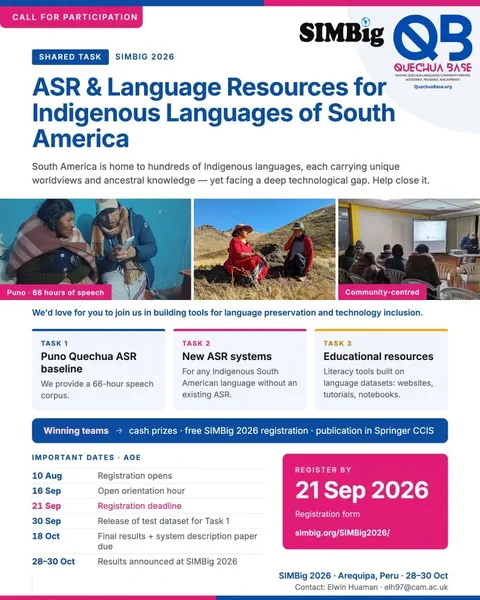 Image credit: Elwin Huaman
Why a shared task?
Most Indigenous languages of South America are still absent from voice-driven AI. Puno Quechua (qxp) is spoken by around 470,000 people in southern Peru, yet until this year it had no dedicated speech recognition (ASR) resources. Speakers are often not literate in their own language, so text-heavy tools leave them out. Speech recognition can meet them where they are: in spoken language.
Between January and February 2026, together with the National University of Altiplano Puno, the Puno Regional Government and the Illariy Ch’aska association, we ran a participatory data collection campaign. 151 native speakers contributed, and the result is the largest speech corpus for any single Quechua variety: 66 hours of scripted and spontaneous speech, released openly under CC0-1.0 on Mozilla Data Collective. We also published the first ASR benchmark for Puno Quechua at AmericasNLP 2026.
A corpus only matters if people use it.
That is why we opened the data to everyone through the SIMBig 2026 Shared Task on Automatic Speech Recognition (ASR) and Language Resources for Indigenous Languages.
What we asked teams to build
The shared task has three tasks, so that both speech researchers and educators could take part:
- Task 1: Puno Quechua ASR. Build a speech recognition system on the Common Voice Scripted Speech and Spontaneous Speech datasets. Systems are evaluated with WER and CER against an open baseline, available on GitHub.
- Task 2: ASR for any Indigenous language of South America. Build ASR for a language that has no system yet, and share the datasets and train/dev/test splits (with a test set of at least 30 minutes).
- Task 3: Educational and literacy resources. Create a website, tutorial, notebook, visualisation, video or learning platform that helps people learn, listen to or reuse an Indigenous language.
Task 3 matters as much as the first two. Speech technology is only useful to a community if it reaches learners, teachers and families, not just leaderboards.
Timeline
| Date (AoE) | Milestone |
|---|---|
| 10 August 2026 | Registration opened |
| 24 August 2026 | Datasets released and orientation hour |
| 16 September 2026 | Second orientation hour |
| 21 September 2026 | Registration closed |
| 30 September 2026 | Task 1 test set released |
| 11 October 2026 | Abstracts submitted |
| 18 October 2026 | Final transcriptions, system papers and videos submitted |
| 28–30 October 2026 | Results announced at SIMBig 2026, Arequipa |
Winning teams receive prizes, free SIMBig 2026 registration and, after revision, publication of their papers in Springer’s CCIS series.
What comes next
Next week we meet in Arequipa to announce the results and hear from the teams. I will update this post with the results, the winning systems and what we learned.
Thank you
Thank you to the co-organisers Johanna Cordova (ERTIM, Inalco), Juan Antonio Lossio-Ventura (National Institutes of Health) and Hugo Alatrista-Salas (De Vinci Research Centre), and to our advisory committee, Anna Korhonen (University of Cambridge) and Damien Nouvel (ERTIM, Inalco). Thank you to every team that registered, to our reviewers, and above all to the Puno Quechua speakers who lent their voices to this work.
Learn more: Shared task page · QuechuaBase · Models on Hugging Face
